Know what fits before you buy
Measure first. Buy storage second.
An original fit checklist for storage: measure the space, the things going inside, and the room needed to use it.
By Things Space · Published
Start with what needs a home
A cabinet can fit a wall and still fail at its job. Before looking at products, pick one small storage problem: shoes by the door, papers beside a desk, or supplies that keep taking over a counter.
Make three piles: keep here, keep elsewhere, and no longer needed. Measure the largest item in the first pile, including anything that sticks out. Record how often you use it.
Three measurements, not one
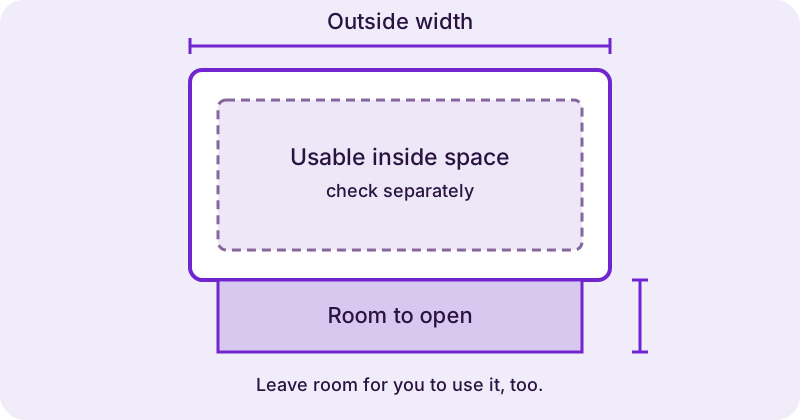
- Outside fit: note the usable width, height, and depth of the location. Measure at more than one point; a baseboard, trim, or projecting handle may be the tightest spot.
- Inside fit: compare your items with the product’s usable compartment dimensions, not just its outside dimensions. If those are missing, ask the seller before ordering.
- Working fit: mark where drawers, doors, lids, and the person using them will go. A closed cabinet’s footprint is not its working footprint.
Use one unit throughout your notes. Try a removable paper footprint on the floor, then walk through your normal routine. Keep exits, vents, and access to equipment unobstructed.
A simple fit calculation
Illustrative example—not a real product: a recess measures 32 inches wide at its narrowest point. A proposed cabinet is 30 inches wide.
32 − 30 = 2 inches of total spare width. Centering it would leave 1 inch on each side, before accounting for installation instructions, hardware, or uneven walls.
That calculation does not prove the cabinet fits. A drawer that cannot open, a top that projects beyond the base, or a required mounting gap can still rule it out. Check the assembled dimensions and the instructions before deciding.
Choose the shape around the routine
| If your priority is… | Consider… | Check before buying |
|---|---|---|
| Frequent access | Open shelving or a reachable bin | Usable opening and the way you lift items out |
| Keeping contents out of sight | A cabinet with doors | Door swing and access beside other furniture |
| Separating small items | Drawers or divided containers | Internal dimensions and full opening depth |
| Avoiding a new purchase | Moving or repurposing existing storage | Condition, fit, intended use, and instructions |
No shape wins every time. Start with access and fit, then compare appearance and cost. “Smaller” is not automatically safer or more useful.
Do not leave safety until assembly day
CPSC’s Anchor It campaign urges anchoring furniture with drawers, doors, and shelves to the wall to prevent tip-over injuries. Include that requirement in your plan, especially before buying a piece for a space where installation may be difficult.
Follow the product’s assembly, anchoring, and load instructions. If you rent, resolve permission and the appropriate installation method before purchasing; do not treat an unanchored required installation as a workaround.
Take the useful part with you
Your storage-fit shopping sheet
Give each measurement a job: the outside must fit your room, the inside must fit your things, and the opening must fit your routine.
My storage-fit note
Measurements help you shortlist; they do not certify fit, load capacity or a safe installation.
Check packed dimensions and the route into your home too. Assembled fit and delivery fit are separate questions.
Your notes stay in this page and are not saved when you leave. Printing opens your browser’s print dialog. You can also copy the prompts onto paper.
Take your next step
Keep your notes handy while you shop, and check the instructions for the exact product you choose. A little planning now makes it easier to bring the right thing home.